Fiber vs. Cable: Why Speed Is Only Part of the Story
- admin691592
- 1 day ago
- 2 min read
When shopping for internet service, most people focus on the advertised download speed. You will often see advertisements for "1 Gig" cable and "1 Gig" fiber and assume they provide the same experience. In reality, they do not.
The biggest differences are upload speed, consistency, latency, and performance during busy hours.
Comparing Fiber and Cable
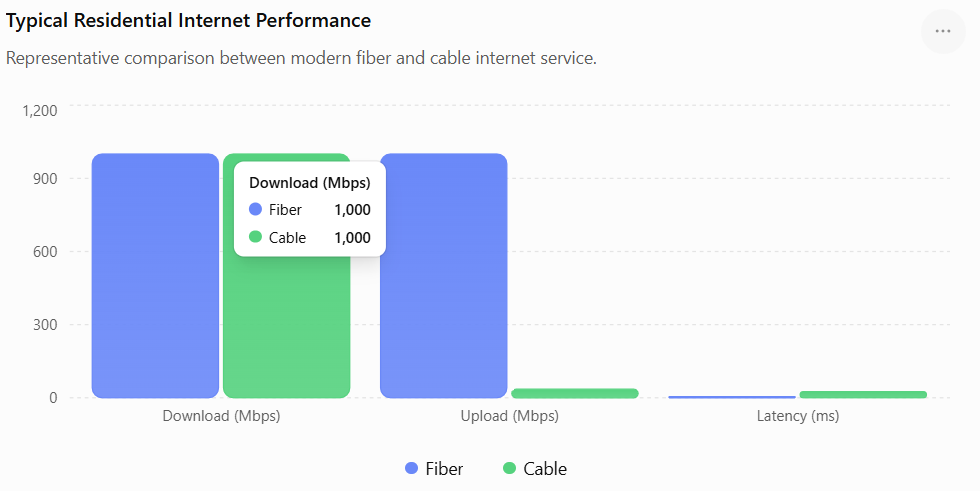
Download Speed
For streaming movies, browsing the web, or watching YouTube, both fiber and modern cable can provide excellent download speeds. If all you do is consume content, you may not notice much difference between a gigabit cable connection and a gigabit fiber connection.
Upload Speed Changes Everything
Modern households upload far more data than they did just a few years ago.
Every time you:
Join a Zoom or Teams meeting
Back up photos to the cloud
Upload security camera footage
Work from home
Send large files
Play online games while others stream
...your upload connection becomes critical.
Most cable providers still offer much slower upload speeds than download speeds. A "1 Gig" cable plan may provide only 20–50 Mbps of upload capacity.
Fiber is different.
Fiber connections are typically symmetrical, meaning a 1 Gig service provides approximately:
1,000 Mbps download
1,000 Mbps upload
That is up to 20–50 times more upload bandwidth than many cable services.
The Hidden Difference: Latency
Latency is the amount of time it takes data to travel between your device and its destination.
Think of it like reaction time.
Lower latency means:
Video calls stay clear.
Games respond instantly.
Websites load faster.
Remote desktops feel local.
Cloud applications perform better.
Two internet connections with identical download speeds can feel dramatically different because one has much lower latency.
Performance During Peak Hours
Cable internet is a shared neighborhood network.
As more homes use the network during evenings, everyone competes for the same bandwidth. This can lead to slower speeds and increased latency during peak usage.
Fiber networks generally have far greater capacity and are engineered to scale much more efficiently, making performance much more consistent throughout the day.
Reliability
Fiber uses pulses of light through strands of glass.
Cable internet relies on electrical signals traveling over coaxial cable.
Because fiber is immune to electromagnetic interference, it generally provides:
More stable connections
Fewer service interruptions
Better long-distance signal quality
Lower maintenance requirements
Which Technology Is Better?
If your internet usage is limited to web browsing and streaming television, both technologies can work well.
However, households increasingly depend on:
Remote work
Video conferencing
Smart home devices
Cloud storage
Online gaming
Multiple simultaneous users
For these applications, fiber consistently delivers a better experience because it combines:
Symmetrical upload and download speeds
Lower latency
More consistent performance
Better scalability
Higher long-term reliability
The Bottom Line
Internet speed is more than the number shown in an advertisement.
A 1 Gig fiber connection and a 1 Gig cable connection may advertise the same download speed, but they deliver very different real-world experiences. Faster uploads, lower latency, and greater reliability make fiber the preferred technology for today's connected homes—and for the growing demands of tomorrow.
Comments